A woman is standing and explaining something to a group of seated women.
Self-help group, Kabul.
© WHSA/WHI

The Taliban are increasingly restricting the rights of women in Afghanistan: They deny women access to education, impose strict dress codes, and force them out of public life. In self-help groups, women work together to develop strategies for coping with these circumstances, strengthen their skills and find ways to earn their own income.


Local partner

The Women’s Hope Social Association (WHSA) works to promote a free, safe, and self-determined life for women in Afghanistan. The organization advocates for women’s access to education and employment, as well as for their recognition and participation in society.


Objectives

Afghan women gain new knowledge and skills that enable them to achieve greater financial independence, raise awareness of gender-based violence and take active steps to prevent child marriage.


Activities

Supporting and accompanying the self-help groups where women learn practical skills while also discussing sensitive topics. This enables them to identify opportunities to improve their situation.


Participants

Around 2,300 women are directly involved in the self-help groups and nearly 14,000 family members benefit indirectly.

Afghanistan’s population suffers from political instability and widespread poverty. The situation of women in the country is further exacerbated by the Taliban’s restrictive policies: The Taliban have systematically excluded women and girls from schools, universities and public life—curtailing their rights and silencing their voices.
 

Deeply rooted patriarchal norms in the country have contributed to the widespread prevalence of gender-based violence, including child marriage. At the same time, the Taliban have systematically dismantled mechanisms designed to protect women. As a result, violence against girls and women remains largely invisible, leaving those affected without support.
 

The consequences of the ban on education for girls and women are devastating. According to UN Women, the ban is expected to lead to an approximately 45 percent increase in teenage pregnancies in the country over the next few years. UN Women also warns that maternal mortality will rise significantly as the number of female healthcare professionals declines. At the same time, the Taliban require women to be treated exclusively by female healthcare professionals, further limiting their access to essential healthcare and putting their health and lives at serious risk.

Titel: Women Support Women in Kabul and Sheberghan
Local Partner: Women’s Hope Social Association (WHSA)
Project Region: Kabul, the capital in the east of the country, and Sheberghan in the north
Duration: January 2025 to December 2026 (follow-up project)
Intervention Areas:
Eliminating gender-based violence
 

Despite the increasingly harsh reality they face, Afghan women continue to demonstrate remarkable courage. Through this project, we seek to strengthen their resilience and support them as effectively as possible.

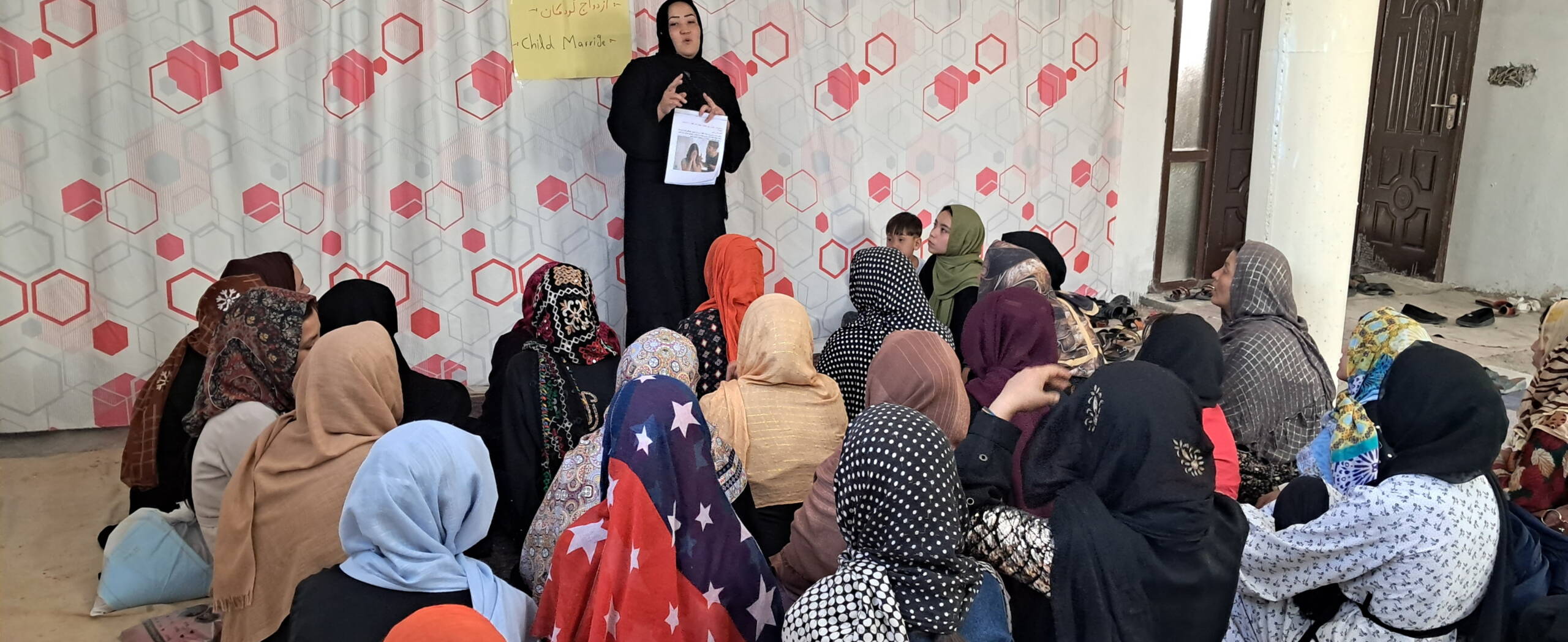
Women are sitting on the floor and listening to a woman holding up a picture.
Exchange and discussion in a self-help group.
© WHSA/WHI

During the first phase of the project, our local partner organisation established around 130 self-help groups between 2021 and 2024, with an interruption due to security concerns. The groups have continued to operate and have even had some unexpected positive effects. For example, women bring their daughters along, and other participants teach them how to read and write.

What we do

In the current project phase, we:

strengthen networks
by supporting existing self-help groups through twelve trained women who coordinate activities and present educational content in an accessible way. Representatives from individual groups regularly exchange ideas with members of other groups to share knowledge and develop joint strategies for promoting their concerns.
 

promote women’s financial independence by providing practical skills training within the groups under professional guidance. This includes for example making soap, sewing and embroidering hijabs. Through their own income, women strengthen their position within their families and in society.
 

strengthen women’s knowledge and awareness by enabling group leaders to address issues such as child marriage and women’s rights in a context- and conflict-sensitive way and by encouraging women to engage in discussions. This allows participants to expand their knowledge, build confidence and identify ways to improve their situation.

Given the country’s catastrophic economic situation, the Taliban currently tolerate projects aimed at people’s livelihoods and financial circumstances. The vocational training primarily serves this purpose. At the same time the groups provide women with a safe space to discuss sensitive and critical issues.
 

Although this strategy has been successful so far, the safety of the women involved remains our highest priority. The project team therefore takes a range of precautionary measures to ensure their safety as effectively as possible.

Sustainability

Thanks to the flexible and accessible approach of the self-help groups, they can quickly adapt to changing circumstances. For example, group leaders are increasingly avoiding the use of physical training materials so as not to leave any traces.
 

Within the groups, the women develop strategies for dealing with their situations and can carry these strengths back to their families and personal lives. By bringing the groups together at a broader level, the project aims to create supportive networks that strengthen one another and extend beyond individual goals.

Logo SDC
Logo Däster Schild Foundation

We would like to thank all our funding partners – including those not mentioned here – for making this project possible.

Notsituation im Bangladesch
Prekäre Lage in fdsfs für Frauen und Kinder

Self-help group training

For many women, self-help groups are the only safe spaces where they can share their experiences and issues in confidence.
© WHSA/WHI