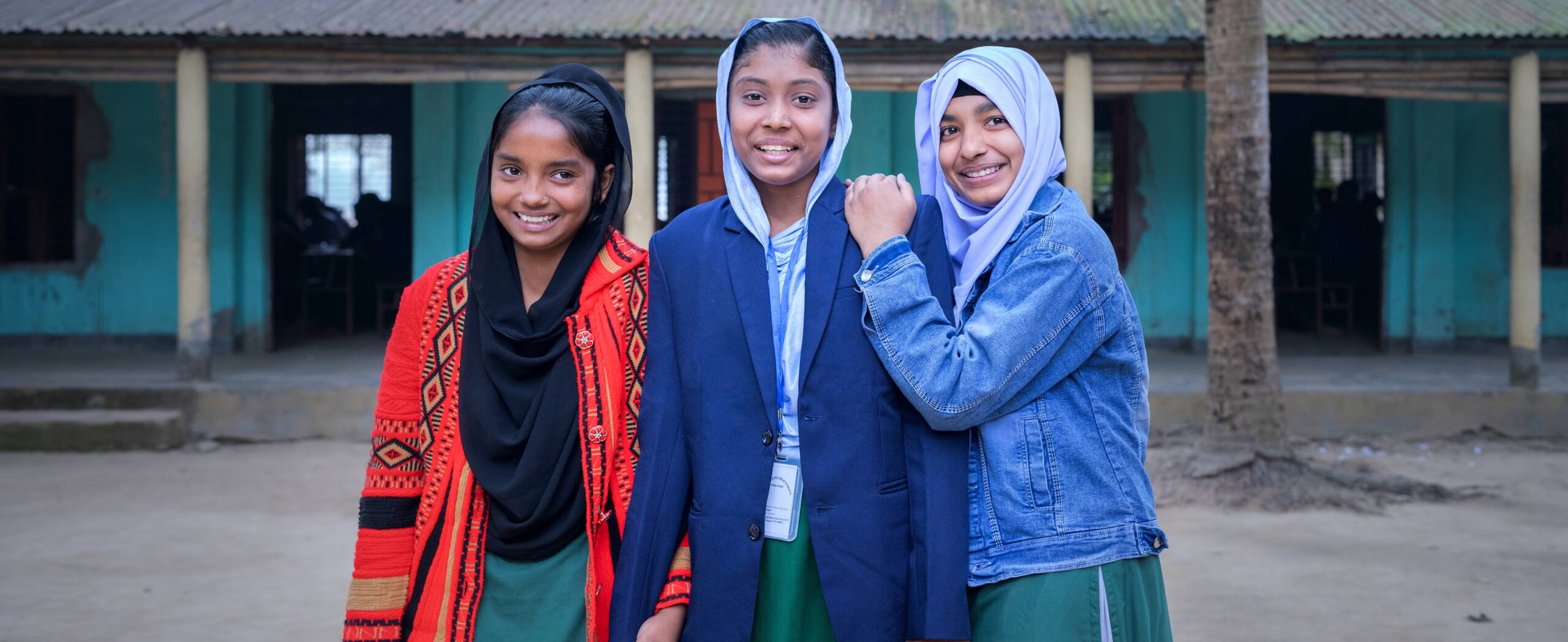
Three girls are leaning against each other and looking at the camera.
A brighter future through strength: girls in Bangladesh.
© Fabeha Monir/WHI

Child marriage is one of the most severe forms of gender-based violence. In Bangladesh, rates are rising again – with devastating consequences: girls lose control over their lives, drop out of school and risk their health through early pregnancy. Our project empowers them – and promotes social change.


Local partner

Lutheran Aid to Medicine in Bangladesh (LAMB), one of the leading healthcare providers in the project region with many years of experience implementing community-based projects to prevent child marriage.


Objectives

By promoting an equal and violence-free society, young women are empowered and cases of child marriage are sustainably reduced.


Activities

Encouraging critical reflection on the issue among different groups, strengthening girls socially and economically, and supporting healthcare infrastructure.


Participants

Almost 12,000 girls and boys under the age of 18, approximately 11,000 people from their immediate communities and around 136,000 people reached indirectly.

Bangladesh has the highest rate of child marriage in Asia, even though the practice has been prohibited by law since 1929. The causes of child marriage are complex, ranging from poverty and social pressure to religious beliefs and inadequate government protection.
 

The number of child marriages in Bangladesh is currently increasing again, partly due to the difficult economic situation. This development is devastating. Child marriage robs girls of their childhood, their dreams and their rights. Many affected girls experience further forms of violence from their partner or their communities throughout their lives – physical, psychological and economic.
 

Forced marriage also often means the end of a girl’s education. This reduces her opportunities for professional development, earning her own income and participating in society. Many girls consequently become trapped in a cycle of dependency and poverty.

Title: A Childhood Without Marriage – Prospects for Girls in Parbatipur
Local partner: Lutheran Aid to Medicine in Bangladesh (LAMB)
Project region: Parbatipur sub-district, Bangladesh
Duration: July 2025 to June 2029 (Follow-up project)
Intervention areas:
Eliminating gender-based violence

Women’s Hope and LAMB have been working to combat child marriage in the Parbatipur sub-district in north-western Bangladesh since 2018. The region’s population is under significant economic pressure, which increases the risk of girls being married at an early age.

Girls are sitting in a circle on the floor; a woman is standing in front of them.
By exchanging experiences, girls learn about their rights – and how to stand up for one another.
© Fabeha Monir/WHI

What we do

We promote an equal society that takes a clear stand against child marriage by bringing together adolescents and parents as well as local authority figures in a suitable and safe setting to discuss gender norms, the legal situation and the dangers of child marriage. By training teachers and so-called "Champion Fathers," who take on a public role model function in the fight against child marriage, we reach additional groups.
 

We support teenage girls in building confidence and gaining access to resources through Safe Spaces, where they can meet, share experiences and learn. In these Safe Spaces, girls can also access menstrual hygiene products. Girls in particularly vulnerable situations receive training, scholarships and material support to help them build a livelihood – for example, through support to acquire a goat – enabling them to develop career prospects and earn their own income. So-called 'Aunties' – trusted female confidantes – and trained teachers provide young people with psychological and social support, and refer them to appropriate institutions when needed.
 

We improve access to high-quality healthcare for teenage girls – whether married or not – by supporting local health facilities in improving their services related to family planning, pregnancy and childbirth and in becoming more financially sustainable in the long term. By issuing official birth certificates, we increase the chances of girls avoiding child marriage later in life.
 

We promote institutional change by bringing together government authorities, police and law enforcement agencies, as well as local politicians, to coordinate efforts to prevent child marriage and strengthen institutional child protection mechanisms.

Strong voices against child marriage

Find out how our local partners are helping to drive social change.

Sustainability

The project creates a sustainable impact by empowering girls and young women through education, training and income-generating opportunities. At the same time, it promotes social change by involving various stakeholders and supporting local authorities and politicians in consolidating protection structures in the long term.

Logo SDC
Logo David Bruderer Foundation

We would like to thank all our funding partners – including those not mentioned here – for making this project possible. 

Notsituation im Bangladesch
Prekäre Lage in fdsfs für Frauen und Kinder

Exchange mothers

The fight against child marriage requires awareness at all levels. Women discuss the risks associated with the practice …
© Fabeha Monir/WHI