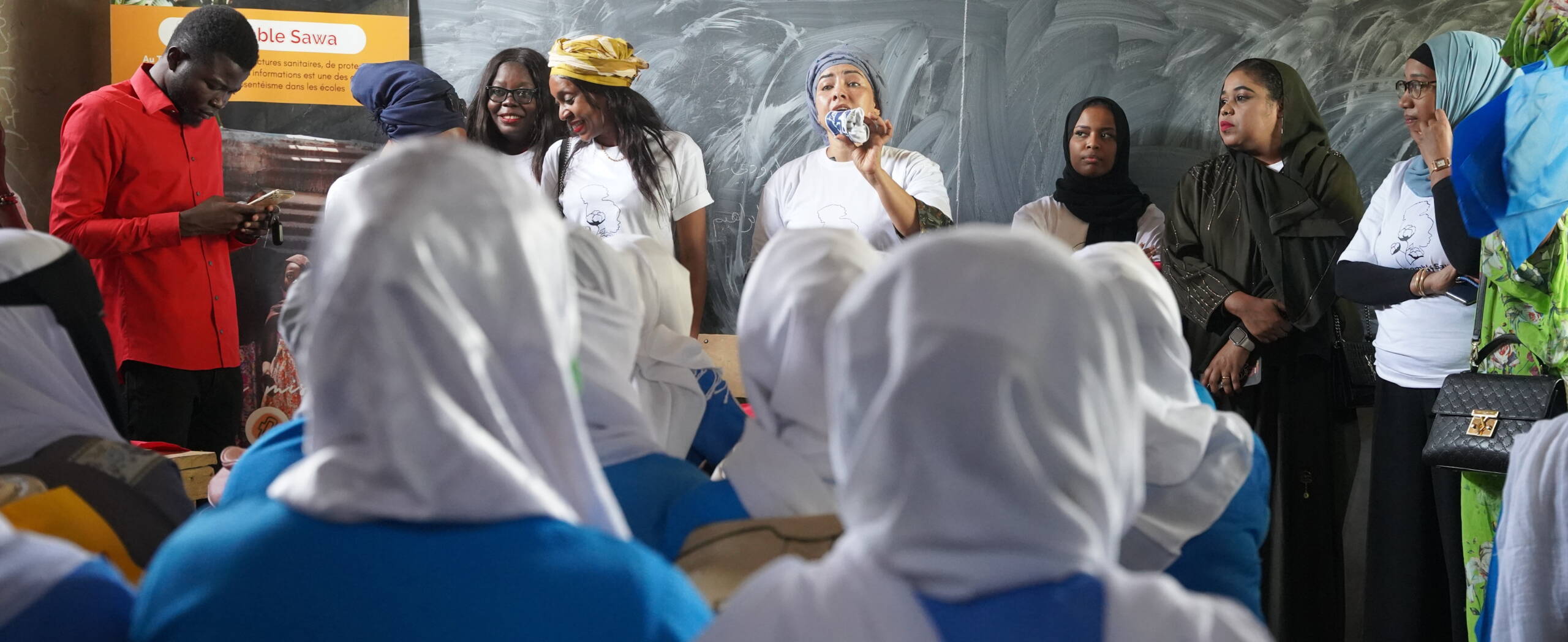
Women are standing in front of a school class. One of them is explaining something and holding a bandage up in the air.
Menstrual health education at a school, Chad.
© Ensemble Sawa

Menstruation is a natural part of life, yet it remains heavily stigmatized. In Chad, many girls miss school during their periods, have no access to menstrual hygiene products and face stigma. Through education, the provision of menstrual products and the creation of a supportive environment, our project aims to improve their opportunities.


Local partner

Ensemble Sawa is Swiss-Chadian NGO that advocates for menstrual health. It provides girls in Chad with sanitary products and raises awareness about menstrual health.


Objectives

Teenage girls are empowered to manage their periods with confidence and in a supportive environment, enabling them to continue their education without restrictions.


Activities

Distributing menstrual hygiene products to girls, conducting awareness-raising activities involving influential community members, engaging in public outreach and improving school infrastructure.


Participants

Around 7,500 people are directly involved in awareness-raising activities, including approximately 3,500 girls who also receive menstrual hygiene products. Almost 13,000 people are reached indirectly through the project.

Ensuring that women and girls can manage their periods with dignity requires more than menstrual hygiene products. They need clean and safe toilets, as well as knowledge and an environment where menstruation can be discussed openly and without taboos. When these conditions are lacking, this is referred to as period poverty. It is estimated to affect 500 million people worldwide.
 

In Chad, many girls do not have access to sanitary products, which are often expensive. Schools frequently lack toilets, soap, clean water and waste bins. Many girls miss school during their periods, with far-reaching consequences: the lack of education limits their prospects and increases the risk of child marriage. This can trap girls in a cycle of poverty that is difficult to escape.

Title: Removing the educational barrier of menstruation: breaking taboos and providing practical support for girls in Chad
Local partner: Ensemble Sawa
Project region: N’Djaména and Chari-Baguirmi provinces
Duration: July 2025 to December 2025 (inception phase), January 2026 to December 2027 (pilot project)
Intervention areas:
Strengthening the healthcare system
 

Together with our partner organization Ensemble Sawa, we are working in four secondary schools in the capital and the surrounding area. We aim to improve the menstrual health of schoolgirls, promote knowledge about the female cycle within communities and break down existing stigmas.

Girls in blue school uniforms proudly hold up reusable sanitary pads.
Access to education thanks to sanitary products: girls at a school in Chad.
© Ensemble Sawa

What we do

We support girls in managing their periods with dignity by investing in school infrastructure to improve hygiene conditions. We also provide female students with reusable sanitary pads and period underwear – a first in Chad – sustainably produced by specially trained local seamstresses.
 

We promote knowledge and understanding by covering a range of topics related to menstruation in three sessions for each class at the participating schools.
 

We raise awareness among government and local stakeholders by organizing dialogue sessions with influential religious, traditional or local decision-makers. Gynecologists and a midwife accompany these discussions, contributing their expertise and answering questions.
 

We help break down taboos by engaging parents through awareness-raising sessions and theatre performances. Through targeted media work, we aim to bring the issue into public and political debate.

Sustainability

By raising awareness among students, parents and communities, we help break down taboos and promote lasting changes in attitudes. The involvement of key figures at government and community level, together with media activities, further contribute to the project’s sustainability.
 

In addition, the project uses locally produced, reusable menstrual hygiene products. Their production by trained seamstresses strengthens local capacities and creates local economic value.

Logo SDC

We would like to thank all our funding partners – including those not mentioned here – for making this project possible. 

Support us!

Donate now for empowered women – protected lives

Notsituation im Bangladesch
Prekäre Lage in fdsfs für Frauen und Kinder

Reusable sanitary pads

Three specially trained seamstresses hired for the project produce the reusable sanitary pads locally.
© Ensemble Sawa