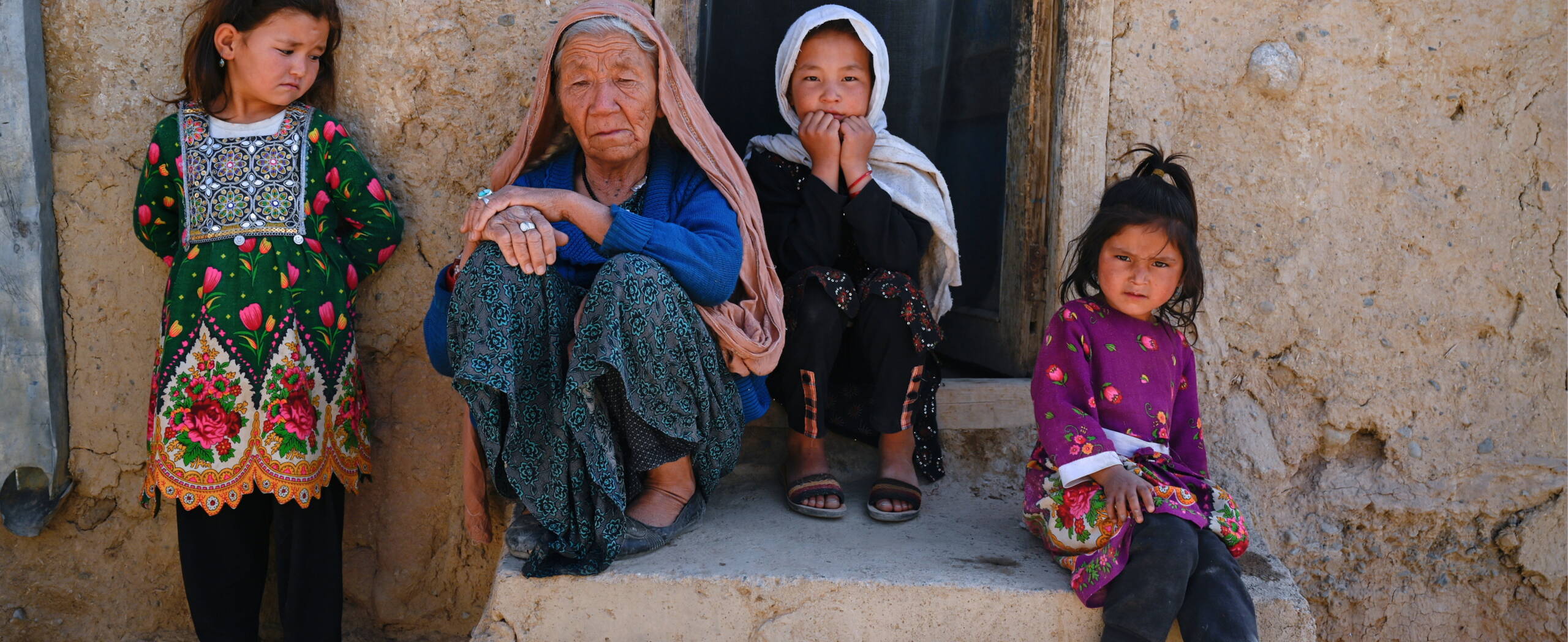
An old woman is sitting on a flight of stairs, with three girls sitting next to her.
They refuse to give up: Girls and women in Afghanistan.
© Nava Jamshidi/WHI/Fairpicture

Five years ago, the Taliban once again seized power in Afghanistan. Since then, they have systematically expanded their system of rule. There is a strategy behind this: resistance – particularly by women – is to be suppressed before it can even take root.

Published 12 August 2026

Please note: To use our resources as efficiently as possible, we used AI-based tools to support the translation of this page. Despite careful review, the translation may contain occasional errors or inaccuracies. Thank you for your understanding.

For Afghan girls, the school gates close at the age of twelve – usually forever. The Taliban ban girls from attending school beyond the sixth grade. Afghanistan is the only country in the world with such a ban – with devastating consequences: “For many families, going to school was a reason to delay marrying off their daughters. When girls can no longer attend school, the risk of early marriage increases significantly,” says Parisa H., a staff member of our local partner organisation.
 

Once a marriage has taken place, girls have little opportunity to divorce. “They remain dependent on their husbands and their husbands’ families for the rest of their lives – whether they are treated well or not is simply a matter of luck.”

A girl is standing by a river, holding a scarf over her head.
An uncertain future: Girls in Afghanistan.
© Nava Jamshidi/WHI/Fairpicture

Legalised cruelty

Child marriage is in fact on the rise again under the Taliban. A recently issued decree allows fathers to marry off their daughters before they reach puberty. It is just one of numerous regulations through which the Taliban systematically restrict the rights of women and girls and increasingly exclude them from public life. Violence against women and girls – described as “discipline” – is now also legally permitted.
 

These laws show how Taliban rule has changed: since August 2021, they have consolidated their power step by step. What initially relied primarily on violence and arbitrary rule has evolved into a system in which oppression is enshrined in law.

Shattered hopes

The Taliban’s strategy is clear: by excluding girls from education and women from the labour market, they prevent them from developing intellectually and achieving economic independence. This undermines the conditions for organised resistance and reinforces existing power structures. At the same time, enshrining the ban on girls’ education in law relieves the state of its responsibility to provide educational opportunities for girls.
 

“The Taliban are afraid of educated women,” says Parisa H. During the twenty years when they were not in power, she says, the Taliban experienced the influence women could gain through education. “Educated mothers are particularly critical when speaking to their sons and husbands. That is extremely dangerous for the Taliban.”

Girls and women are washing cooking pots in a river.
For the Taliban, their place is clear: Afghan girls and women doing housework.
© Nava Jamshidi/WHI/Fairpicture

Patriarchal gender roles have long been deeply rooted in Afghanistan. But before the Taliban’s return to power, women had at least some legal protection. “We used to have hope. We believed it was worth challenging social norms and, when necessary, standing up to our own families in order to live self-determined lives. Today, even legislation legitimises the oppression of women.”

Humanitarian crisis – and a hesitant international community

This oppression is unfolding against the backdrop of a severe humanitarian crisis. A struggling economy, declining international aid and the escalating conflict between Afghanistan and Pakistan have left around 23 million people in Afghanistan dependent on humanitarian assistance.
 

Military escalation between the United States and Iran, as well as ongoing tensions with Pakistan, have disrupted important trade routes and largely cut Afghanistan off from international trade. Rising prices are further exacerbating an already dire humanitarian situation – with particularly severe consequences for women and girls.
 

Poverty, for example, also drives child marriage. “Many families marry off or sell their daughters out of sheer financial desperation,” says Parisa H. Less poverty would also mean less violence against girls and women. Parisa H. therefore calls on the international community to step up its humanitarian engagement and, above all, to exert political pressure. “Afghanistan cannot exist without relations with other countries. Those countries should use their position to put pressure on the Taliban.”

Girls are walking along a wall, carrying bowls on their heads.
At risk of child marriage: Girls in Afghanistan.
© Nava Jamshidi/WHI/Fairpicture

At present, however, there are few signs of this. In June, representatives of the European Union received Taliban representatives in Brussels – despite the EU’s refusal to recognise the Taliban. Human rights organisations have criticised the meeting, which reportedly focused primarily on discussions about the return of rejected Afghan asylum seekers.
 

While the international community struggles to determine how to engage with the Taliban, the regime continues to consolidate its policy of repression. For millions of Afghan women and girls, this means that the erosion of their rights is increasingly being enshrined in law – and resistance is becoming ever more difficult.

Our work in Afghanistan

In Afghanistan, we support 130 self-help groups in which more than 2,000 women meet regularly. They support one another, develop strategies for navigating everyday life under the Taliban and learn practical skills that enable them to earn their own income. We provide organisational support to the groups and fund the salaries of local project staff. To help alleviate the participants’ severe financial hardship, we also distribute food packages containing flour, oil and rice.
 

The Taliban currently tolerate this work because it improves the economic situation of women and their families. At the same time, the self-help groups provide a safe space where women can also discuss sensitive issues. The safety and protection of everyone involved is our highest priority.

Notsituation im Bangladesch
Prekäre Lage in fdsfs für Frauen und Kinder