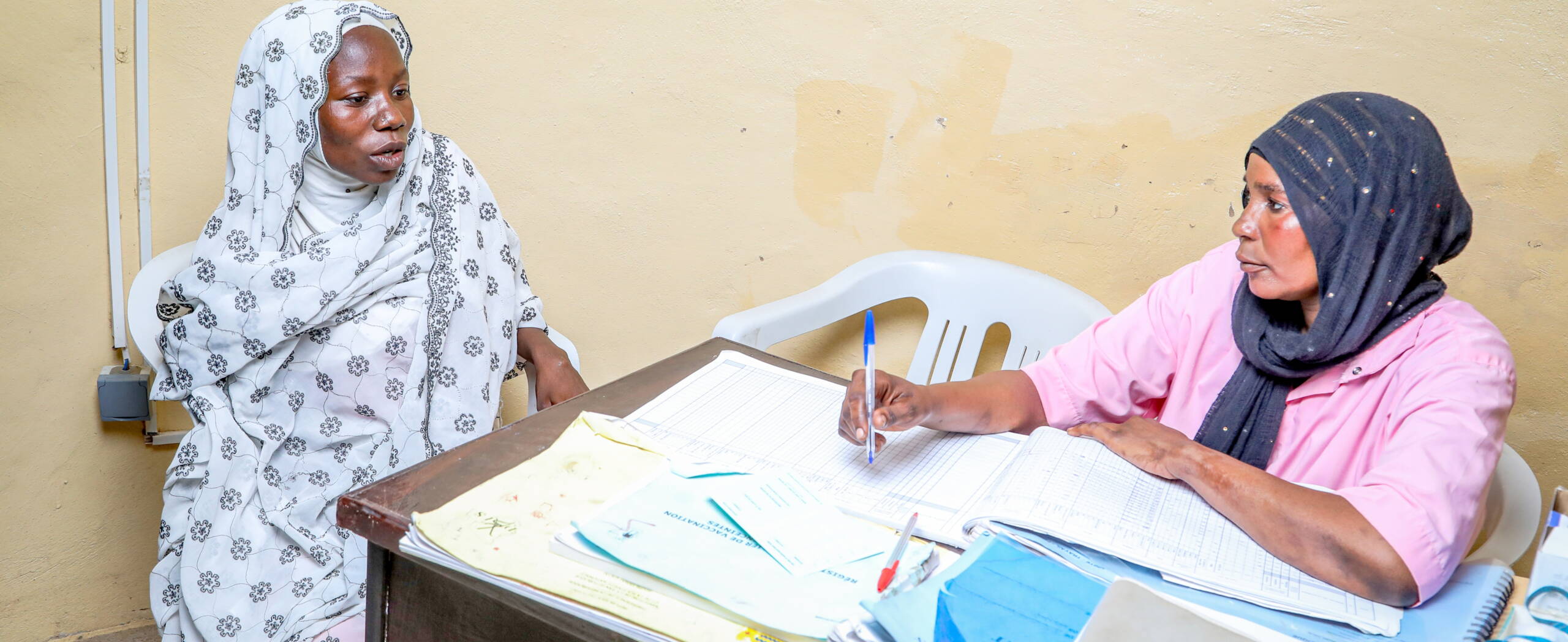
Hebamme im Gespräch mit einer Patientin im Tschad
Examination by a midwife, Chad.
© Salomon Djekorgee Dainyoo/WHI/Fairpicture

Our new app, “Notre Bébé et Nous”, supports families in Chad throughout pregnancy, childbirth and the first months with their baby. But how can we reach people who have neither internet access nor a mobile phone?

Published 10 March 2025

Please note: To use our resources as efficiently as possible, we used AI-based tools to support the translation of this page. Despite careful review, the translation may contain occasional errors or inaccuracies. Thank you for your understanding.

In many rural areas of Chad, the necessary infrastructure is lacking. Internet access is expensive and unreliable, not every family owns a smartphone, and high levels of illiteracy make written information difficult to access.
 

These barriers show that digital solutions alone are not enough – they need to be adapted to local realities.
 

That is why we have developed several approaches to make the app accessible, inclusive and easy to understand – even without an internet connection or the ability to read.

How it works

  • If someone has already downloaded the app, they can share it with other families who have a smartphone via Bluetooth – without needing an internet connection.

  • For people who cannot read, the app's audio function provides information in Chadian Arabic or French.

  • To make the app accessible to people without smartphones, we have provided tablets at local health centres. Women can use the app while waiting for their consultations.

  • Finally, we plan to print out the app's content so that it can also be used offline.

Screenshots der Applikation Notre Bébé et Nous, Tschad
App Notre Bébé et Nous.

The app is divided into seven categories, covering everything from antenatal care, birth preparation and childbirth to the first days at home with the baby and postnatal check-ups. It addresses all the key stages and provides essential information for safe childbirth and postnatal care.

Getting fathers involved, too

The app is deliberately called “Notre Bébé et Nous” because we want to encourage families to see childbirth as a shared responsibility between partners. The app actively involves men in the process, for example by encouraging them to accompany their partners to antenatal appointments or be present during childbirth.

Männer sitzen im Kreis bei einer Gemeinschaftsbefragung im Tschad
Community survey of men, Chad.
© Salomon Djekorgee Dainyoo/WHI/Fairpicture

What's next?

The app is now live and being tested by people in the local communities. Our partner BASE wants to find out whether it provides genuine support in everyday life. Is it easy to understand? Does it work reliably? And is it reaching the families who need it?
 

Notre Bébé et Nous is an important addition to the valuable work of healthcare professionals – not a replacement for it. The app makes health information more accessible to women and their families in a simple, easy-to-understand way, without unnecessary barriers. Because the health of mothers and children should never depend on education, financial resources or where they live.

Notsituation im Bangladesch
Prekäre Lage in fdsfs für Frauen und Kinder