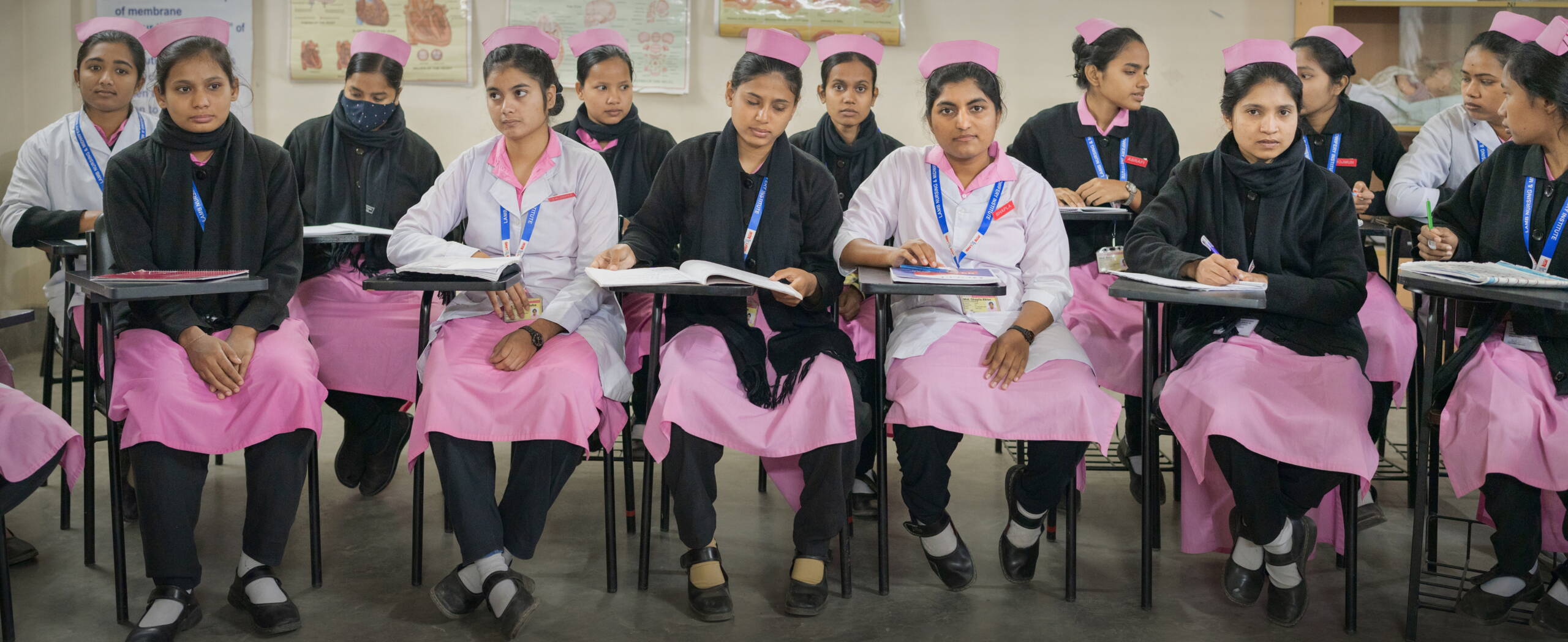
Young women are sitting on chairs, with small desks and textbooks in front of them.
Midwifery students, Bangladesh.
© Fabeha Monir/WHI

In rural areas of Bangladesh, many women give birth without medical assistance – often with life-threatening consequences. In the north-west of the country, we support midwifery training and help young women from low-income families pursue a meaningful profession.


Local partner

LAMB (Lutheran Aid to Medicine in Bangladesh) combines healthcare provision with education and training. To this end, LAMB runs its own midwifery college as well as a hospital specialising in maternal healthcare.


Objectives

To increase the number of well-trained midwives so that they can improve healthcare for mothers and newborns in underserved areas.


Activities

Financial support for female students, improving the quality of training and the institute’s local integration, and supporting female students in finding employment.


Participants

Around 170 young women receive scholarships to train as midwives, alongside other students who take part in events and activities. Ten teaching staff members receive further training.

The midwifery profession is relatively new in Bangladesh: formal midwifery training programmes have only existed since 2013. Before then, births were generally attended by nurses with additional training or by traditional birth attendants – women who derived their knowledge primarily from their own experience of childbirth.
 

Although Bangladesh has made significant progress in maternal healthcare in recent years, there is still a shortage of midwives, particularly in rural areas. The reasons include poorly equipped training institutions, poverty that prevents many families from financing their daughters’ education, and the low social status of the profession.
 

Even today, more than half of all women in the country give birth without professional assistance. Yet skilled care can make the difference between life and death: studies by the relevant UN agency indicate that qualified midwifery care could prevent up to two-thirds of maternal and newborn deaths.
 

Title: Midwives for Parbatipur
Local partner: Lutheran Aid to Medicine in Bangladesh (LAMB)
Project region: Parbatipur sub-district, Bangladesh
Duration: July 2025 to December 2028 (follow-up project)
Intervention areas: Strengthening the healthcare system
 

To enable more women in rural, hard-to-reach regions to give birth safely, we have been working with the LAMB Nursing and Midwifery Institute in northern Bangladesh since 2022 to support midwifery training.

Midwifery students are standing around a table; a young woman is placing a breathing mask on a baby doll.
Practising for emergencies: midwifery students, Bangladesh.
© Fabeha Monir/WHI

What we do

We support midwifery training, by raising awareness among young people and parents about the importance of the profession and the opportunities it offers. We provide girls from low-income families with scholarships and tutoring programms, and cover the costs of their placements in rural areas. We also promote networking among current and former students to strengthen the connection between training and practical experience.
 

We improve the quality of training, by providing further training for teachers at the LAMB Nursing and Midwifery Institute, carrying out minor repairs and funding teaching materials. Regular evaluations of the programme help to continuously improve its quality. By building targeted links with other healthcare institutions, we facilitate students’ transition into professional life.

Midwife instead of marriage

Discover how Shapla Akter is realising her dream of becoming a midwife.

Sustainability

Through our commitment, we are not only helping to sustainably improve maternal and newborn health in the region but are also empowering young women to build self-determined and independent lives. Former midwifery students who have found employment repay part of their scholarship, thereby enabling other young women to receive an education.

Logo SDC
Logo Catholic Church Region Bern
Logo Lottery Funds Canton of Aargau

We would like to thank all our funding partners – including those not mentioned here – for making this project possible. 

Notsituation im Bangladesch
Prekäre Lage in fdsfs für Frauen und Kinder