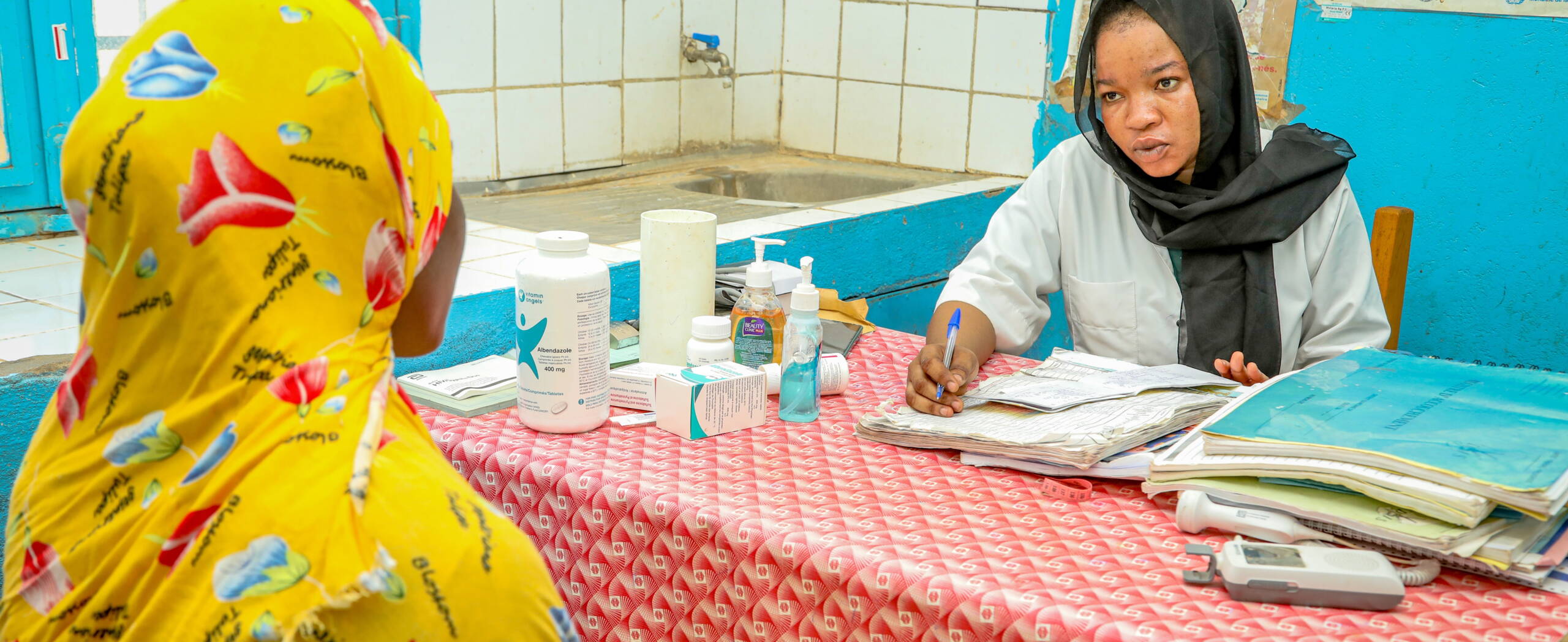
A midwife is seeing a patient.
A midwife attends to a pregnant woman, Chad.
© Salomon Dainyoo/WHI/Fairpicture

Healthcare for women remains particularly precarious in the Ouaddaï region in eastern Chad. Many women are also affected by gender-based violence, including child marriage. We strengthen the local healthcare system both professionally and structurally and promote the autonomy of girls and women.


Local partner

The Bureau d’Appui Santé et Environnement (BASE) is an NGO in Chad that has been working for around 30 years to improve maternal and child health and to support the public healthcare system.


Objectives

Healthcare in the project region is strengthened and made more accessible through the involvement of local communities. Gender-based violence is reduced and survivors receive effective support.


Activities

Strengthening local structures that ensure long-term access to healthcare, training and recruiting healthcare professionals, investing in infrastructure, preventing gender-based violence and supporting survivors.


Participants

Around 70,000 people benefit directly from an improved healthcare system and functioning protection structures, while their wider community – around 50,000 people – benefit indirectly.

The Ouaddaï region in eastern Chad is severely underserved in terms of infrastructure and healthcare personnel. The population suffers from food insecurity and social tensions. The civil war in neighbouring Sudan has led to a massive increase in the region’s population. Host communities are under enormous pressure, while the already fragile healthcare system is stretched to its limits.
 

The consequences are particularly serious for pregnant women: only one in five women gives birth in a healthcare facility, and the maternal mortality rate is 140 times higher than in Switzerland.
 

Furthermore, many women experience gender-based violence, which is deeply rooted in patriarchal structures and sociocultural norms. Child marriage, female genital cutting, rape and domestic violence are widespread and have severe health, social and psychological consequences for survivors.

Title: Working together for health and protection: Strengthening local structures for women, adolescents and children in eastern Chad
Local partner: Bureau d'Appui Santé et Environnement (BASE)
Project region: Abougoudam and Marfa health districts in the Ouaddaï region
Duration: January 2026 to December 2029
Intervention areas:
Strengthening the healthcare system / Eliminating gender-based violence

Together with our local partner BASE, we have been working in eastern Chad since 2019. From the outset, we have taken a community-based approach that actively involves local communities in planning and implementing activities.
 

With the project “Working together for health and protection”, we can build on this experience and further develop proven approaches. The strong foundation of trust enables us to address more sensitive issues, such as gender-based violence.
 

In this new project phase, we support 17 health centres. In addition, we have been providing emergency assistance to Sudanese refugees in the region through a separate project since 2024.

What we do

We improve access to high-quality healthcare for women, adolescents and children by training healthcare personnel and supporting midwives with salaries, further training and scholarships – helping to address the shortage of skilled staff. Training in respectful, non-violent care raises the quality of services, both in maternity care and beyond. We also strengthen health centre infrastructure through new construction, solar panels, water connections and maintenance training for local communities. And to promote awareness of sexual and reproductive health, we rely on youth peer activities, radio programmes featuring healthcare professionals, and the app "Notré Bébé et Nous".

The app ‘Notre Bébé et Nous’ supports families in Chad during pregnancy, childbirth and the early period with their baby. It provides important health information in an accessible way, and also helps reach women with birth injuries through targeted information. The app was piloted in 2025 and has been rolled out more widely since 2026.

We promote resilient and transparent management of the local healthcare infrastructure and its integration into the national health insurance system by supporting the development of standardised tools, training staff and strengthening dialogue between local and central stakeholders. By supporting a collective healthcare financing system, we help ensure sustainable access to healthcare services for all population groups. Local health committees also generate their own funds, which they reinvest in the system to become less dependent on external funding in the long term.
 

We prevent gender-based violence and support affected girls and women by strengthening their autonomy - for example through literacy courses, support in setting up small businesses and the construction of a community centre. We train healthcare personnel to identify gender-based violence and provide sensitive, appropriate support to survivors, with the assistance of a psychologist. Finally, we promote dialogue with government representatives to strengthen their role in prevention and response.

A building with several domes in front of a sparsely vegetated hill.
Maternity wards can save lives.
© Solomon Dainyoo/WHI/Fairpicture

Sustanability

Through local engagement, participatory management and targeted capacity-building, we strengthen communities so that they can manage the health centres independently in the long term. Economic activities undertaken by the communities reduce their dependence on external funding, while promoting the autonomy of adolescents and women strengthens their resilience. Finally, investments in water and energy infrastructure contribute to the long-term functioning of healthcare services in the face of changing climate conditions.

Logo SDC

We would like to thank all our funding partners – including those not mentioned here – for making this project possible. 

Notsituation im Bangladesch
Prekäre Lage in fdsfs für Frauen und Kinder

Examination by a midwife

We contribute to the midwives’ salaries so that they can provide pregnant women with competent and compassionate care.
© Salomon Djekorgee Dainyoo/WHI/Fairpicture