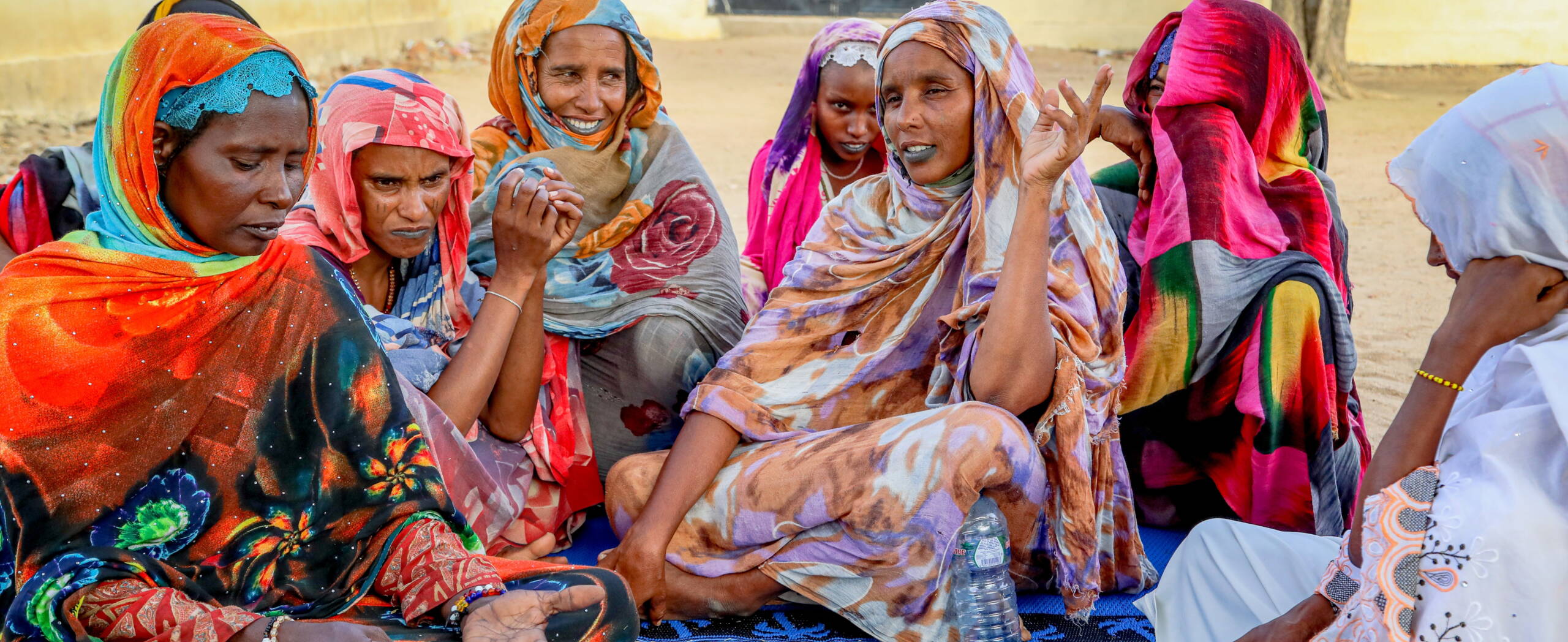
Women in colorful dresses are sitting next to each other. One of them raises her hand to say something.
Women express their needs during a community consultation, Chad.
© Salomon Dainyoo/WHI/Fairpicture

In Chad, around a thousand women each year are left with obstetric fistula following prolonged and complicated childbirth. Our project supports affected women through awareness-raising, medical care and new income-generating opportunities – helping them rebuild their lives and create new prospects for their future.


Local partner

The Bureau National de Recherche en Genre et Développement (BUNARGED) is a women-led Chadian NGO that advocates for the rights and social inclusion of women and girls.


Objectives

Fistula survivors in eastern Chad receive improved medical care, while particularly vulnerable women have the opportunity to improve their living conditions through vocational training.


Activities

Expanding healthcare infrastructure and improving the quality of care, providing economic support to survivors, training healthcare professionals and raising awareness in the communities.


Participants

Around 600 fistula survivors and more than 15,000 other people are directly involved in the project. More than 42,000 people – including relatives and users of an app –benefit indirectly from the project.

Obstetric fistula is usually caused by prolonged or difficult childbirth without medical assistance and is therefore particularly common in rural areas of Chad. Young girls are especially vulnerable because their bodies are not yet fully developed for pregnancy and childbirth.
 

Despite a national strategy on obstetric fistula, Chad, one of the world’s poorest countries, lacks the resources and political will to address the issue comprehensively.
 

The consequences for those affected are devastating: in addition to the profound loss of their child - nine out of ten women lose their baby during childbirth - women suffer from distressing symptoms such as uncontrolled urinary or faecal incontinence.
 

Many women live in social isolation and poverty. In most cases, these severe injuries can be treated, yet many women are unaware that treatment options exist. Access to information is difficult, as only 14 per cent of women across the country can read.

Title: New strength instead of isolation: Fistula survivors create new opportunities
Local partner: Bureau National de Recherche en Genre et Développement (BUNARGED)
Project region: Abéché, Ouaddaï Province, eastern Chad
Duration: July 2024 to October 2027 (pilot project)
Intervention areas:
Treatment of obstetric injuries / Strengthening the health system
 

There are currently only two functioning fistula treatment centres in the entire country. One of them is the Village des Femmes, affiliated with the University Hospital of Abéché. However, the care provided there is inadequate: the existing waiting room is cramped and poorly ventilated, while specialised staff and psychosocial and economic support to help women reintegrate into their communities are lacking. Our project addresses these gaps and aims to improve the conditions and care for women affected by fistula.

A view of a room with hospital beds and women lying on them.
It smells of urine, and not every woman has a bed: the former waiting room at the Village des Femmes.
© WHI

What we do

We improve healthcare at the Village des Femmes by providing further training for existing staff and recruiting additional staff. Training more surgeons will help address the shortage of specialised fistula care. The construction of an additional building will alleviate overcrowding, while new sanitary facilities and reusable sanitary pads will ensure more hygienic conditions for the women. We also provide meals for women during their stay.
 

We provide targeted and individual support to the most vulnerable women through an income-generating programme that helps them re-engage in social and economic life. A psychosocial specialist is also available to support women at the Village des Femmes.
 

We raise awareness by supporting fistula survivors and local women’s groups in educating their communities about the causes of obstetric fistula and encouraging affected women to seek treatment. By training local healthcare workers, we help ensure that fistulas are detected at an early stage and that women can be referred for treatment.
 

We identify fistula survivors through radio campaigns, a counselling hotline and the specially developed app «Notre Bébé et Nous». The app also provides important information on pregnancy, childbirth and potential birth injuries.

Our app «Notre Bébé et Nous» supports families in Chad throughout pregnancy, childbirth and the first months with their baby. It makes important health information accessible in an easy-to-understand way and, through targeted information, also helps to reach women living with obstetric injuries.

Sustainability

Income-generation support is essential for fistula survivors to build self-determined lives in the long term and overcome marginalisation. By taking part in awareness-raising activities themselves, survivors also help change how their communities perceive and treat women affected by fistula.
 

As part of the reintegration process, the project team works with local organisations in Abéché. This collaboration is crucial for ensuring that the project’s achievements can be sustained locally after the project ends.

Logo SDC
Logo Lottery Fund Canton of Aargau
Logo Lottery Fund Canton of Bern
Logo Fondation Philanthropique Famille Sandoz

We would like to thank all our funding partners – including those not mentioned here – for making this project possible. 

Notsituation im Bangladesch
Prekäre Lage in fdsfs für Frauen und Kinder

Construction new hospital room

The waiting room was built using the same construction method as the maternity wards in Chad: the local population can also take part in the construction by stacking sandbags, which are later plastered.
© WHI